




Celebrating Excellence: Our Students Shine at the Jr. NBA All-Star National Championship Selection

nba

We are proud to share that our team delivered a commendable performance at the Delhi NCR 3x3 Jr. NBA Under-14 Basketball Tournament, competing against 112 schools and 448 girls.The team secured an impressive 4th position in this highly competitive event.

Shiv Nadar School proudly congratulates Aaisha Aray (Grade 8) and Saanvi Singh (Grade 9) on being selected among the four elite players to represent the Delhi Team at the Jr. NBA All-Star National Championship.

Award ,

Competition ,

School ,

Samrat Aneja: A Journey of Academic Excellence and Global Recognition

Samrat

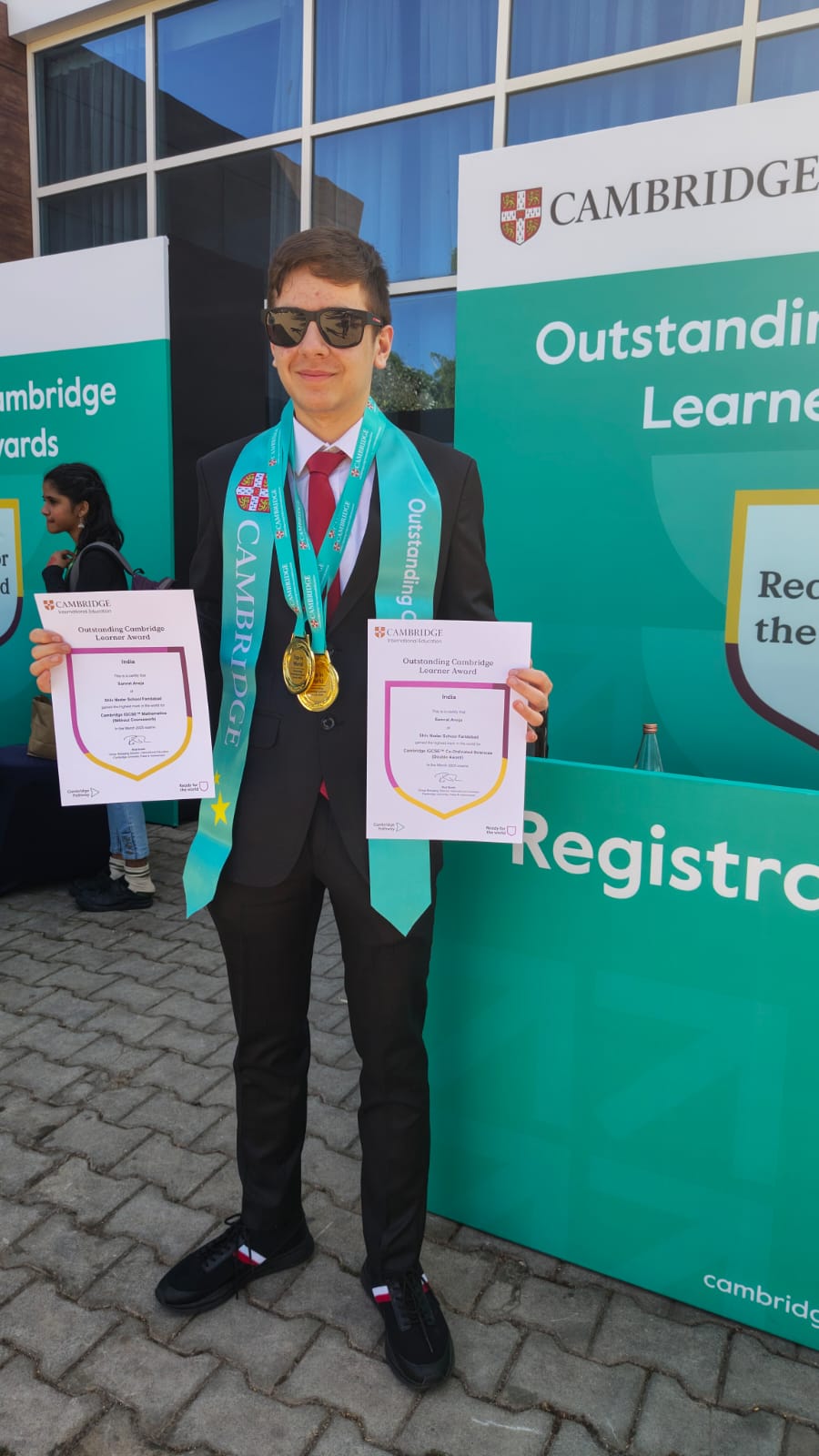
Samrat Aneja, currently a student of IBDP 1 at Shiv Nadar School, Faridabad, has built an academic journey marked by depth, range, and consistent excellence. He was awarded the prestigious Cambridge Outstanding Learner Award – Top of the World for Extended Mathematics, securing a perfect 100 percentile, and for the Co-ordinated Sciences Double Award, becoming the only recipient in India for this subject combination. This global recognition, spanning candidates from the March, June, and November Cambridge IGCSE and A Level examination series worldwide, was conferred at a formal felicitation ceremony held on 23rd January in Bangalore, India.

Complementing this achievement are Samrat’s accomplishments across STEM and language learning. He earned the B1 German Language Certificate (October 2025), secured 2nd Rank in the Infinity Math Challenge organised by Aditya Birla World Academy in the Advanced Category along with a Merit award in the Individual Rounds (January 2026), and achieved 2nd Place in STEM at the IB League hosted by Jayshree Periwal International School (January 2026). He also qualified for the Asian Regional Space Settlement Design Competition (November 2025), was selected for the STEM Best Practice Summit (January 2026), and attained a Distinction in the International Chemistry Quiz (September 2025).

Together, these milestones reflect Samrat’s intellectual rigour, global competitiveness, and sustained commitment to excellence across disciplines—values that align strongly with the learning ethos of Shiv Nadar School, Faridabad.


ALL ,

Arts ,

Award ,

Badminton ,

Board ,

Competition ,

Curriculum ,

School ,

Aayra Kakkar Brings Home Gold in Kickboxing

Kickboxing Achievement

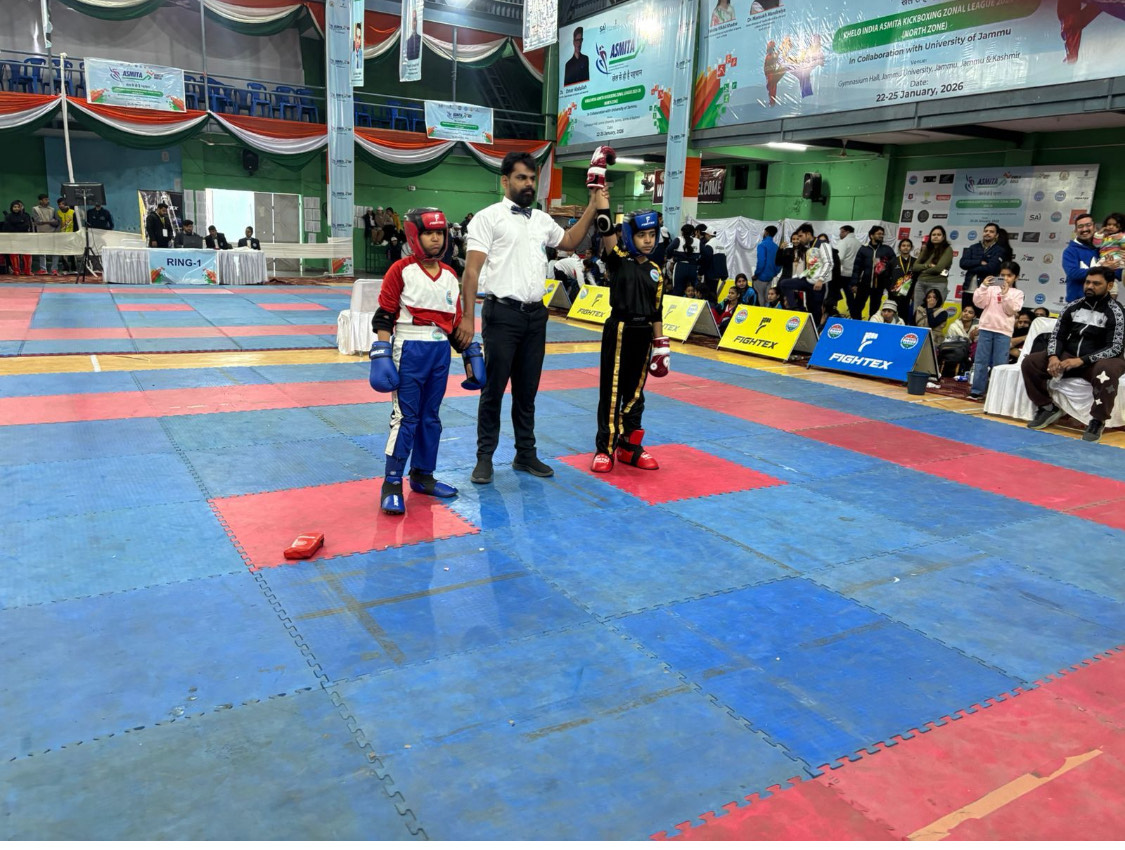
Aayra Kakkar of Grade 6, Shiv Nadar School, Faridabad, has won a Gold Medal in the Younger Cadets Point Fight (-42 kg) category at the Asmita Khelo India Kickboxing Championship 2025–2026 (North Zone). The championship was held at the Gymnasium Stadium, Jammu.

With this outstanding performance, Aayra has also qualified for the National Kickboxing Championship, scheduled to be held in March in Chennai.

We congratulate Aayra on this remarkable achievement and wish her the very best for the upcoming nationals.

ALL ,

Arts ,

Award ,

Badminton ,

Board ,

Competition ,

Curriculum ,

School ,

Shiv Nadar School Chennai is now an Authorized IB PYP World School


Shiv Nadar School, Chennai is now an authorized IB PYP World School and is officially part of the prestigious IB World School community.

This authorization reflects our focus on delivering a high-quality, inquiry-based educational experience. Learning at our school is designed to nurture students who are curious, knowledgeable, and caring, while encouraging them to take responsibility for their own learning.

As we enter this new chapter, we look ahead to deepening student agency, critical thinking, and responsible action, as part of our continued pursuit of educational excellence.


Competition ,

Creative ,

Cricket ,

Curriculum ,

Dance ,

Economy ,

Education ,

Education For Life ,

Environment ,

Fitness ,

IB ,

Innovation ,

Leadership ,

Lifestyle ,

Middle ,

Music ,

Nature ,

Nutrition ,

Outbound Learning ,

Parenting ,

Performing Arts ,

Philosopy ,

Pre Primary ,

Primary ,

Progressive ,

Reading ,

Relationships ,

School ,

School Life ,

Science ,

Secondary ,

Senior Secondary ,

SNS Guest ,

Soccer ,

Speaker ,

Sports ,

Theatre ,

Travel ,

Visual Arts ,

Welness ,

Writing ,

Where Learning Takes Shape: The Role of Makerspaces in Schools

Walk into a classroom today, and you can sense a quiet change. Learning no longer lies in a single correct answer on the board. Students are taking things apart, putting ideas together, and discovering that real understanding often grows through doing.

This is where makerspaces come in.

A makerspace is a room where students feel free to try things out. They experiment, make mistakes, laugh about them, and try again. Curiosity shows up in half-built models, scattered tools, and conversations that continue long after the bell rings. It is a place where ideas slowly turn into things you can see, test, and improve.

What is a Makerspace?

A makerspace is a shared learning space built around making and experimenting rather than passive listening. It supports creativity, resilience, problem-solving, collaboration, and real-world application, all of which students need in an ever-evolving world.

Inside, you might see:

  • Digital fabrication tools: 3D printers, Laser cutters, Metal lathes, Wood lathes
  • Electronics & robotics: Arduino, Raspberry Pi, micro:bit, sensors
  • Woodworking & metalworking tools and Machines
  • Crafting and prototyping materials
  • Collaborative zones for brainstorming, design thinking, and project documentation


It is essentially a space where ideas meet tools and creativity finds expression.

Here, students feel comfortable saying, “Let me see what happens if I try this.” Mistakes feel normal. Reflection becomes part of the rhythm of the work.

Why makerspaces matter in schools

Makerspaces shape the way students experience learning. They gently move learning from knowing into creating.

They encourage creativity and problem-solving.
Students meet obstacles and learn to work through them. Problems begin to feel like puzzles to explore rather than barriers.

They make STEM and STEAM concepts real.
A bridge that falls apart explains balance. A stubborn program explains logic. Understanding grows through experience.

They build collaboration in a natural way.
Students plan together, combine ideas, and create something shared.

They allow different learning speeds.
Some students jump straight into building. Others watch quietly, think, and then begin. Both approaches feel welcome.

What a makerspace contains is important. The culture inside it matters even more.

Tools help. Culture transforms.

An impactful makerspace grows from:

  • a clear learning purpose connected to the curriculum
  • design thinking habits
  • safe and easy access to tools
  • teachers who feel confident guiding open-ended work
  • student clubs, maker fairs, and community challenges
  • links with project-based learning, sustainability, and real-world problem-solving

Students begin to teach themselves, explore on their own, and take ownership of ideas. The makerspace becomes part of the school’s way of learning.

How makerspaces change the learning experience

When students see an idea turn into something they can touch, learning feels different.

Projects start to feel personal. Work becomes something they care about, not just a task to finish. Motivation comes from pride and curiosity.

Different kinds of learners find their space too. The builder, the observer, the dreamer, the coder, the artist. Each one belongs.

A connection to the real world

What happens in a makerspace feels similar to what happens in design studios and labs outside school.

Students test ideas, build prototypes, talk through what went wrong, and try again. There is space for more than one answer. Over time, they become comfortable with uncertainty and open-ended work.

What happens inside a school makerspace?

On any regular day, you might see:

  • a robot that takes an unexpected turn
  • a 3D-printed piece that works on the second or third attempt
  • students redesigning something because the first version did not work
  • towers and bridges being tested for strength

There is focus, laughter, and the familiar sentence, “Wait, I think I know what to try next.”

The long-term impact on students

With time, makerspaces change the way students see themselves.

They become more willing to stay with difficult problems.
They learn that confusion is temporary.
They begin trusting their own ideas and instincts.

Better academic understanding follows, but something deeper grows beneath it: confidence, patience, empathy, and curiosity.

Why makerspaces matter today

Makerspaces recognise how children naturally learn. They explore, build, imagine, get messy, and try again. They connect science, design, engineering, arts, and technology in ways that feel real and meaningful.

At Shiv Nadar School, Chennai, the makerspace is often full of students who hope for a few extra minutes. They return to unfinished projects, celebrate small breakthroughs, and sometimes take everything apart to begin again. The space reminds us what learning feels like when it is alive, joyful, and genuinely hands-on.

2026-01-23

Design Thinking in Schools: A Blueprint for Future Innovators

Children are natural problem-solvers. Give them a puzzle, a loose screw, or a situation that feels slightly confusing, and they instinctively start exploring possibilities. This instinct of theirs needs to be recognised as a strength. Learning is no longer seen as simply arriving at the right answer; it is also about how students approach a question, what they observe, and how they respond when things don’t work the first time.

Design thinking sits beautifully in this space.

It offers a simple, repeatable way to understand a problem, think through options, and try ideas in real contexts. Instead of rushing to solutions, students pause, observe, and listen. They learn to understand who they are designing for, what truly matters in a situation, and how ideas evolve when tested in the real world.

Over time, this way of thinking builds confidence. Students begin to realise that uncertainty is not a barrier; it is a starting point.

What is Design Thinking in Schools

Design thinking is a process of working through problems thoughtfully and creatively.

In classrooms, it looks like students:

  • observing a situation closely
  • listening to people involved
  • framing the core problem clearly
  • suggesting many ideas instead of one
  • building simple prototypes
  • testing and refining their work

It builds habits of curiosity, reflection, and iteration. Students learn to balance imagination with practicality, using skills to act on the needs and ideas they uncover.

The Five Stages of Design Thinking

Design thinking unfolds through five connected stages. Each stage invites students to think a little deeper and notice a little more.

1. Empathise

Students begin by understanding people and contexts. They talk, listen, observe, and ask questions. They try to see situations from another perspective. This creates a sense of purpose that guides everything that follows.

2. Define

From all the observations, students identify what actually needs attention. They clarify the challenge rather than tackling everything at once. A well-defined problem gives direction and meaning to the work ahead.

3. Ideate

With a clear purpose in mind, students explore ideas openly. They think widely, allowing imagination to respond to what they have seen and heard.

4. Prototype

Ideas take visible shape. A sketch, a model, a storyboard, or a simple mock-up helps turn intention into action. Skills begin to grow naturally as students try to make their ideas work in the real world.

5. Test

Students try out what they have created. They notice what works, what doesn’t, and why. Feedback becomes part of learning, helping them refine both their thinking and their approach.

Through this cycle, students begin to see that improvement is a natural outcome of responding thoughtfully to real needs

Why Teach Design Thinking in Schools?

It begins with purpose and empathy
Students learn to notice people, situations, and challenges around them. This sense of purpose gives meaning to what they create and guides the choices they make along the way.

It strengthens thinking through action
As students work toward addressing real needs, they assess information, weigh options, and make thoughtful decisions. Skills grow as part of trying to make an idea useful, not as an end in themselves.

It supports communication and collaboration
Most design-thinking tasks involve teams. Students explain ideas, listen closely, and work through differences. They experience what it means to build something together for a shared purpose.

It nurtures holistic learning
Design thinking connects science, art, technology, humanities, and everyday life. Learning feels linked by meaning rather than divided by subjects.

How Design Thinking Shapes Future Innovators

Students who practise design thinking begin to:

  • stay attentive to the needs around them
  • adapt when situations change
  • treat mistakes as part of understanding
  • remain curious for longer
  • approach challenges with calm

These habits form the foundation of innovation. They prepare students to step into changing careers, unfamiliar roles, and new technologies with both skill and intention.

What Design Thinking Looks Like in Classrooms

Design thinking in schools doesn’t always have to appear through large projects. Often, it shows up in small, thoughtful moments:

  • redesigning everyday objects to make them easier to use
  • rethinking shared community spaces
  • creating simple prototypes for sustainable products
  • building and testing robots to solve practical problems
  • working on social impact projects in the school or neighbourhood
  • designing posters, apps, or interfaces to meet real needs

The focus remains on moving from understanding to action, shaped by reflection along the way.

A Way of Thinking That Stays With Students

Design thinking helps students become calm, flexible thinkers who are willing to try, reflect, and try again. It nurtures empathy alongside creativity, judgement alongside imagination. It helps students see themselves as capable of shaping the world around them, thoughtfully and responsibly.

At Shiv Nadar School, it finds a natural place in everyday learning, shaping the way students approach questions, ideas, and the world they are growing into. Here, design thinking is a way of learning, not a one-time activity. It shapes how students question, empathise, experiment, and respond to real-world challenges. By valuing process over quick answers, the school nurtures confident problem-solvers who are comfortable with uncertainty and capable of thoughtful action. Embedded in everyday learning, design thinking prepares students to shape the future with purpose and responsibility as truly holistic learners who embody our values and vision.

2026-01-23

Subscribe to Jan 2026