




Congratulations to Avviraaj Kalia and His Father

Avviraaj Kalia

Avviraaj Kalia, a proud student of Shiv Nadar School Faridabad, along with his father Mr. Akhil Kalia, showcased exceptional skill and teamwork at the Parent-Child Golf Tournament held today at Delhi Golf Club.

They not only secured First Place in their category, but also emerged as the overall winners of the event with an outstanding score of 12 under in 20 holes, including a thrilling 2-hole playoff.

What an inspiring display of talent, discipline, and family spirit—Congratulations to the Kalia family for this remarkable win!

Arts ,

Award ,

Badminton ,

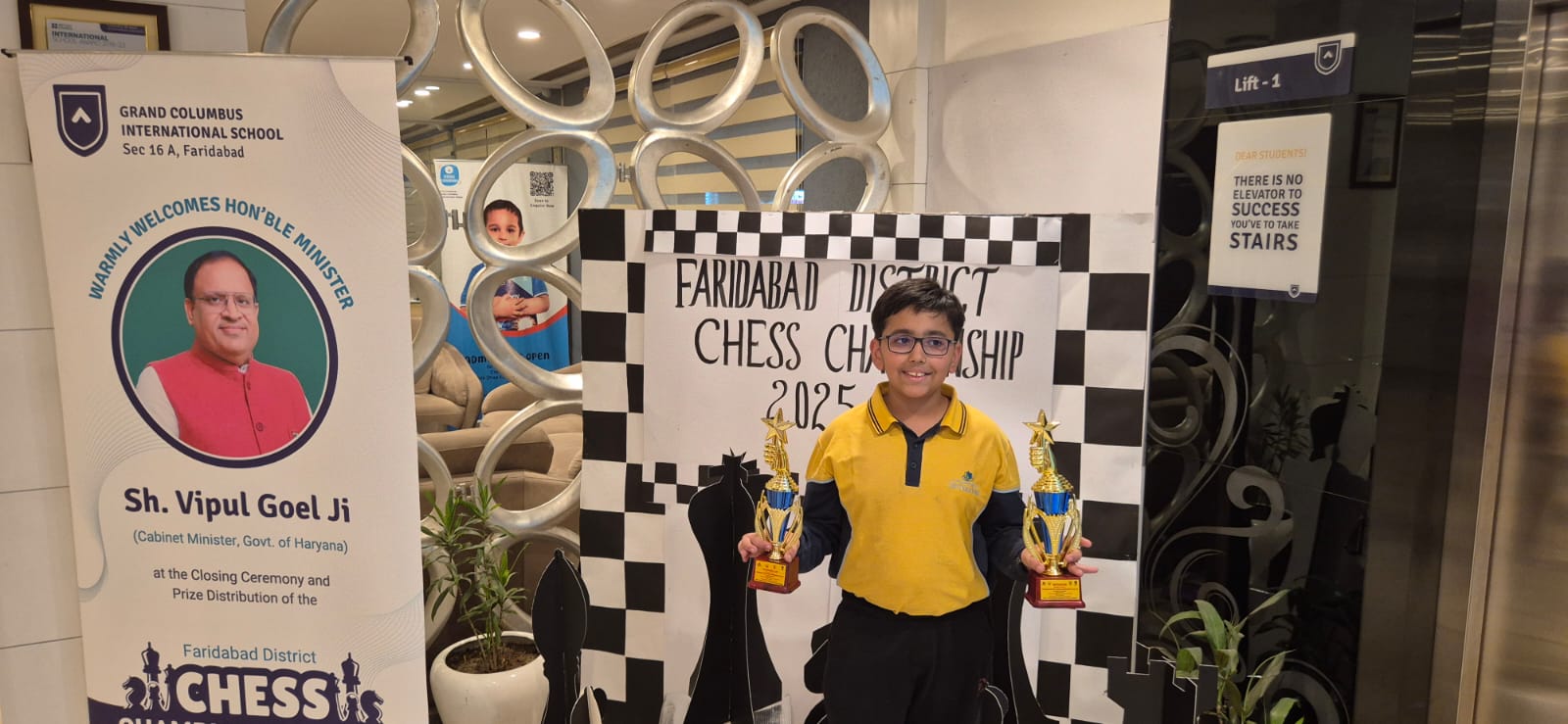
Jayansh Dhingra Shines at Faridabad District Chess Tournament

Jayansh Dhingra

Jayansh Dhingra from Grade 7 Gir, who delivered an exceptional performance at the Faridabad District Chess Tournament by participating in two higher age categories – Under-13 and Under-15.

Despite the tough competition and intense tie-breaker scenarios, Jayansh displayed remarkable strategic skill and composure, securing:

  • 1st Position in the Under-15 category
  • 2nd Position in the Under-13 category

Both victories were hard-fought, with the final rankings determined through tie-break points, showcasing how closely contested the tournament was.

This isn’t Jayansh’s first moment of glory—he previously won the Under-11 category last year, triumphing with a perfect score by winning all 6 matches.

Jayansh’s consistent performances across multiple age groups are a testament to his dedication, sharp analytical thinking, and love for the game of chess.

Arts ,

Award ,

Badminton ,

Mahira Dua Secures 6th Position in U-11 Girls Chess Category

Mahira Dua

Mahira Dua from Grade 5 Sariska for securing 6th position in the Under-11 Girls category at the Faridabad District Chess Tournament. Her dedication and composure on the chessboard reflect her growing confidence. We’re excited to see her evolve as a young chess enthusiast.

Arts ,

Award ,

Badminton ,

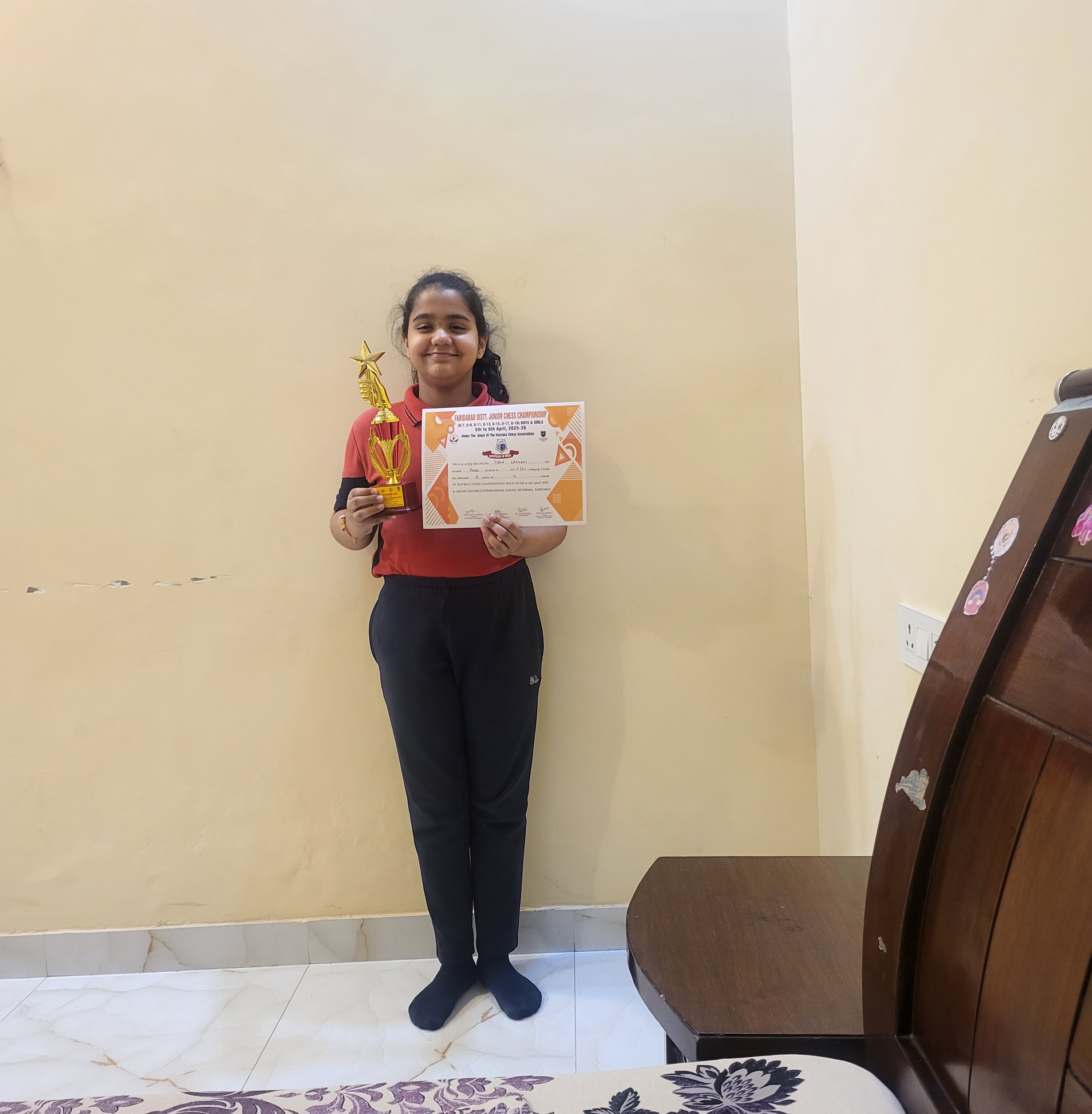
Tisha Lakhani Shines at District-Level Chess Tournament

Tisha Lakhani

Tisha Lakhani, a student of Grade 6 Ranthambore at Shiv Nadar School, Faridabad, secured the 2nd position in the Under-11 category at the District-Level Chess Tournament held at DPSG, Faridabad on 16th April 2025.

This remarkable achievement is a testament to her sharp analytical thinking, dedication and growing passion for the game.

We applaud her performance and look forward to her continued success in the world of chess.

Arts ,

Award ,

Badminton ,

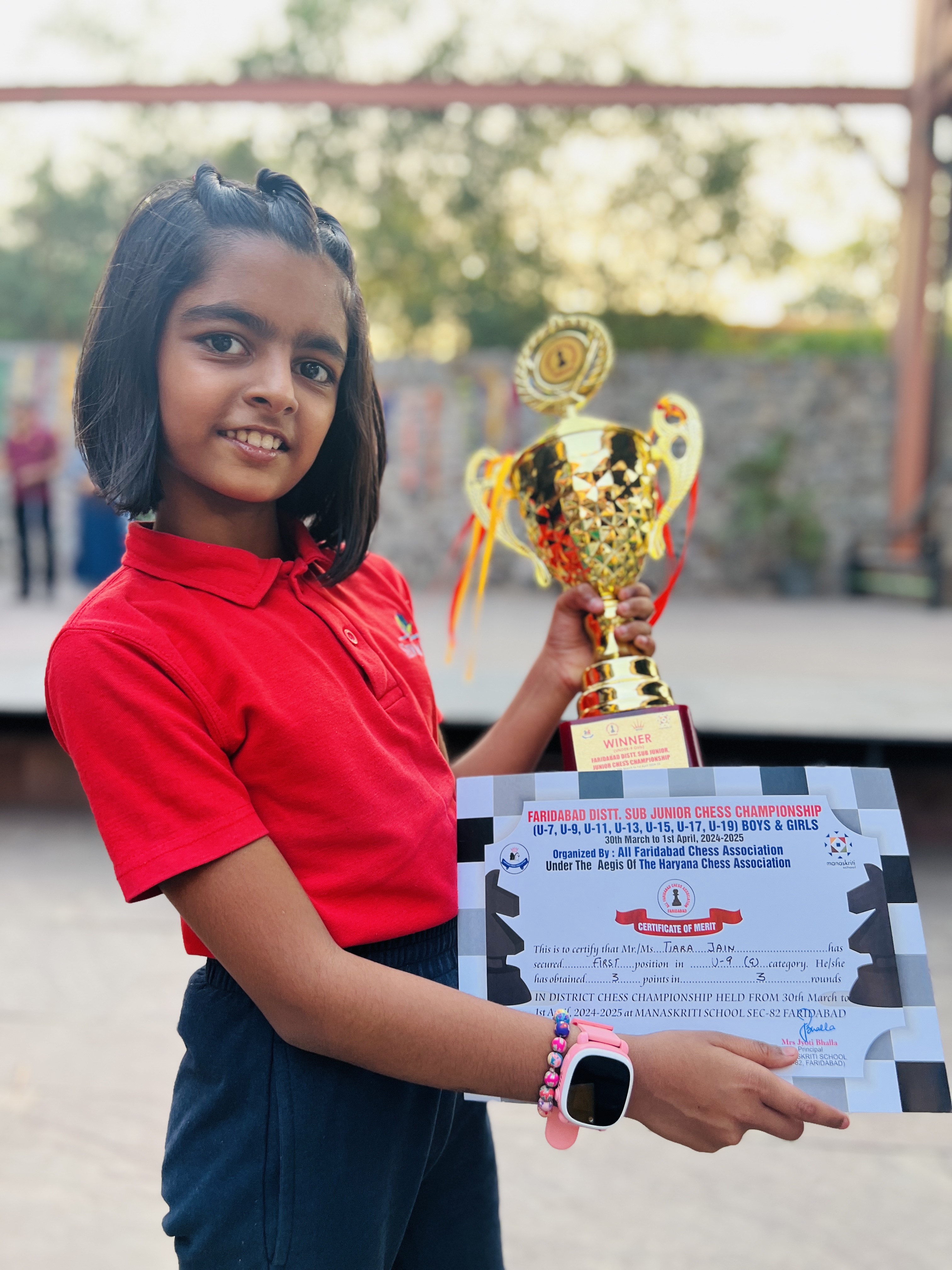
Tiara Jain Shines at Faridabad District Chess Championship 2025

Tiara Jain

Tiara Jain, a student of MYP 1 at Shiv Nadar School, showcased her talent at the Faridabad District Chess Championship 2025. At just 10 years of age, Tiara secured an impressive 5th position in the Under-11 Girls category and 4th position in the Under-13 Girls category. Her commendable performance across two age groups highlights her growing confidence and skill in the game.

Arts ,

Award ,

Badminton ,

Shiv Nadar School Noida is now an IB MYP Authorised School

Shiv Nadar School, Noida, approaches learning as a purposeful journey driven by curiosity, where every child is encouraged to ask questions, explore passions, and develop the confidence to take on future challenges. Besides being an IB DP authorised school, we’re now also authorised to offer the International Baccalaureate (IB) Middle Years Programme (MYP). This reflects our ongoing commitment to meaningful education that prepares students for the world they live in today, and the one they will help shape tomorrow.

What the MYP Brings to Our School

The Middle Years Programme is designed for students aged 11 to 16 and encourages them to make connections across subjects, explore real-world issues, and build essential skills for life. Critical thinking, collaboration, research, and reflection are integral to the programme's design. For example, in Grade 7, students might investigate climate change through Science, Geography, and Language and present solutions using persuasive speeches and data visualisation. They develop research skills, collaborative strategies, and reflection habits that are taught and assessed. The IB MYP helps students understand how they learn, why they learn, and how their learning can make a difference.

What makes the IB MYP unique is its focus on developing students who are thoughtful, open-minded, and engaged with the world. The programme helps them grow academically while also encouraging them to care deeply about their community and the wider world.

Why It Matters

As parents, you want your children to be confident, capable, and compassionate individuals. The IB MYP provides an environment where students are encouraged to think independently, take ownership of their learning, and explore new ideas with depth and purpose. Regular reflection, peer feedback sessions, and self-assessment checklists enable students to learn to monitor their progress, set personal goals, and apply their learning in meaningful contexts. This prepares them well for the demands of higher education and supports their growth as responsible global citizens.

The programme is recognised worldwide and provides a strong foundation for the IB Diploma Programme, which many of our students pursue in Grades 11 and 12. With the IB MYP in place, their learning experience is part of a seamless, thoughtfully designed continuum.

The Journey to Becoming an IB MYP School

Gaining authorisation as an IB World School offering the MYP involves curriculum alignment, intensive teacher training, and a deep engagement with the IB’s educational philosophy. It is a result of the effort, dedication, and collaboration of our entire community, teachers, students, school leaders, and parents. Our students now experience a seamless continuum from the Middle Years through to the Diploma Program due to the IB MYP authorisation. This ensures that skills like critical thinking, research, and intercultural understanding are intentionally built over time, preparing them for lifelong learning.

We will continue to build a school experience where students learn with intention and grow with confidence. Being part of the IB community connects us to a global network of schools that value academic excellence, student well-being, and international-mindedness.

2025-08-13

What Makes the IB Diploma Programme Unique?

Each learner carries a distinct lens through which they view the world.
What if an academic programme didn’t just acknowledge that individuality and natural inclination, but also nurtured depth, curiosity, and a strong sense of purpose?

At Shiv Nadar School, we believe education should do more than deliver content. It should build character, ignite curiosity, and equip students with the tools to think independently, ethically, and deeply. The International Baccalaureate Diploma Programme (IB DP) reflects this belief in both spirit and structure.

From Grade 11 onwards, our students enter a programme that invites them to understand ideas, ask meaningful questions, and develop clarity of thought, not simply recall information.

Learning That Connects Across Contexts

In the IB, learning is not confined to silos. Students are encouraged to explore how disciplines overlap, revealing patterns and ideas that bridge traditional subject boundaries.

A science lesson may spark an ethical discussion in Theory of Knowledge (TOK). A historical case study might inform creative writing in literature. This interconnected approach helps students make real-world connections and strengthens their ability to transfer learning between contexts.

Balancing Breadth and Depth

The IB Diploma requires students to choose six subjects across different academic groups: languages, humanities, sciences, mathematics, and the arts. This ensures a broad foundation and reflects the IB’s commitment to well-rounded learning.

Three subjects are pursued at Higher Level (HL), offering depth and intellectual rigour. The remaining three are taken at Standard Level (SL), providing balance and space to pursue areas of strength or interest. The IB recommends 240 contact hours for HL subjects and 150 contact hours for SL. Students are guided carefully in this process, allowing them to shape a personalised academic path within a structured framework. Every subject discipline in the IB DP has an internal assessment component that provides a scope for the student to plan and demonstrate their individual learning.

A Core That Builds Character and Thinking

At the heart of the programme lie three core components that shape how students think, act, and reflect:

  • Theory of Knowledge (TOK) encourages students to question how knowledge is constructed. They explore different methods and tools, that involve both cognitive and physical tools. Logic, emotion, imagination, intuition and language come under cognitive tools.
     
  • The Extended Essay (EE) is a 4,000-word independent research paper. Students choose a topic they care about, conduct formal academic research, and build writing and critical thinking skills that are essential for university and beyond.
     
  • Creativity, Activity, Service (CAS) takes students beyond the academic timetable. Through arts, sports, and community engagement, students discover new interests and reflect on their place in the world. They also develop compassion and caring attributes towards society.
     

Together, these components create learners who are intellectually sharp, self-aware, and socially conscious.

Critical Thinking as a Daily Practice

A defining feature of the IB experience is the space it gives students to think independently. They are not just asked to answer questions, but to examine how those questions are formed — and what assumptions, generalisations, biases and logical fallacies lie beneath them.

They learn to evaluate information, explore and evaluate perspectives, and develop arguments rooted in evidence. This habit of inquiry builds academic strength as well as a deep sense of intellectual agency.

Learning with a Global Mindset

The IB invites students to engage with global issues while staying grounded in local realities. It develops international mindedness in students by identifying human commonalities and acknowledging them. Whether through literature, environmental systems, or the study of current events, learners are encouraged to explore diverse perspectives and build cultural awareness.

At the same time, they are asked to consider their responsibilities within their own communities. This balance between global awareness and local action helps shape thoughtful, ethical decision-makers.

A Journey That Shapes Lifelong Learners

What makes the IB Diploma Programme unique is not a single feature, but the way its elements come together to nurture learners who are curious, confident, and compassionate.

It invites students to be active participants in their learning, to explore their interests with rigour, and to grow into people who think deeply and act ethically.

2025-07-21

Cultivating Curiosity: The Importance of Theory of Knowledge in the IB Diploma Programme

In the International Baccalaureate Diploma Programme, students don’t just study facts, interpretations, laws or theories; they learn to question them. At the heart of this inquiry lies Theory of Knowledge (TOK), a distinctive and defining feature of the IB Diploma. TOK invites students to ask, How do we know what we know?

What Is Theory of Knowledge?

TOK is one of the three core components of the IB Diploma Programme, alongside the Extended Essay (EE) and Creativity, Activity, Service (CAS). It invites students to explore the nature of knowledge across disciplines, prompting them to reflect on how knowledge is created, evaluated, and applied.

Rather than treating knowledge as fixed, TOK encourages learners to consider:

  • What counts as evidence?
     
  • How do emotion, logic, and language shape what we believe?
     
  • What is the relation between knowledge and truth?
     

These questions are examined through two key lenses:

  • Knowledge framework - scope, ethics, methods & tools and perspectives
     
  • Areas of Knowledge - including mathematics, science, history, and the arts
     

Where most subjects teach students what to learn, TOK teaches them how to think about learning itself, a foundational skill in today’s complex world.

Building Skills for a Changing World

In an age of overwhelming information, education must do more than deliver content. It must develop discernment, reflection, and thoughtful engagement. TOK plays a central role in cultivating the competencies that modern learners need most:

Critical Thinking
Students learn to question assumptions, evaluate sources, and build balanced arguments supported by evidence.

Ethical Reasoning
By analysing moral dimensions across knowledge systems, students learn to weigh consequences and act with responsibility.

Cultural Awareness
TOK explores how knowledge varies across cultures and contexts, helping students appreciate diverse perspectives and global complexity.

Communication Skills
Through writing and discussion, learners practise expressing nuanced ideas clearly while listening respectfully to others.

Motivation to Inquire
TOK nurtures curiosity, encouraging students to ask better questions and pursue lifelong learning.

These skills serve students far beyond exams. They prepare them for university, careers, and the ethical and intellectual challenges of adult life.

TOK in Action: Two Key Assessments

TOK is not a theoretical exercise — it’s rooted in application and reflection. Students complete two key assessments that demonstrate their critical thinking in meaningful ways.

The TOK Exhibition

Students select three real-world objects and connect them to one of 35 TOK prompts, such as “What counts as knowledge?” or “Who decides what is true?” The Exhibition challenges them to apply abstract ideas to tangible contexts and reflect on how knowledge operates in their world.

The TOK Essay

This 1,600-word essay responds to one of six prescribed titles released annually by the IB. Students analyse a knowledge question by linking effectively to areas of knowledge, using real-world examples, academic content, and personal insight to construct a clear, coherent argument.

Both assessments develop transferable thinking skills and encourage learners to apply TOK in real-world situations — not to find one “right” answer, but to demonstrate clarity, perspective, and intellectual maturity.

An Interdisciplinary Lens

One of TOK’s greatest strengths is its interdisciplinary nature. Rather than viewing subjects in isolation, students are encouraged to connect ideas across domains and reflect on how different disciplines shape what we know.

For example:

  • How does the idea of proof in mathematics compare to interpretation in literature?
     
  • Can scientific discoveries be influenced by ethical beliefs or political systems?
     
  • What role does storytelling play in shaping history?
     

These inquiries foster a mindset that sees knowledge as interconnected, preparing students to approach real-world problems with both depth and breadth of thought.

Why TOK Matters Now

In a world shaped by artificial intelligence, media complexity, and global uncertainty, it’s not just what students know that matters — it’s how they think.

TOK develops intellectual humility — the recognition that knowledge evolves, is shaped by context, and benefits from multiple perspectives. It teaches learners to resist simplification, to embrace complexity, and to engage with ideas ethically and reflectively.

Today’s students will graduate into futures we cannot fully predict. But with TOK, they’re better prepared, not just to succeed, but to think responsibly, question wisely, and lead with purpose.

TOK at Shiv Nadar School

At Shiv Nadar School, TOK is more than a course, it’s a mindset woven into every corner of our learning environment. In classrooms and collaborative spaces, students explore questions that matter to themselves and to the world around them.

Our educators encourage interdisciplinary connections, link TOK discussions to current events, and help students develop a way of thinking that lasts long after the essay is submitted. Whether they’re debating the nature of truth or reflecting on how different cultures build knowledge, students in TOK learn to think deeply, act responsibly, and grow into intellectually independent individuals.

Conclusion

The true value of TOK lies not in content covered, but in thinking sharpened. It builds the capacity to ask better questions and the confidence to seek meaningful answers.

At Shiv Nadar School, TOK represents what education should be: a space not just for learning, but for reflection, transformation, and growth.

2025-07-21

Beyond the Classroom: How CAS Transforms Learners in the IB Diploma Programme

Some of the most lasting lessons come not from what we study, but from how we choose to act, create, and contribute. In the International Baccalaureate (IB) Diploma Programme, Creativity, Activity, Service (CAS) transforms learning into lived experience. It becomes the space where students move from understanding the world to engaging with it thoughtfully, ethically, and with purpose.

At Shiv Nadar School, CAS is not an add-on. It is woven into the very fabric of our learning culture, where curiosity meets compassion, and ideas evolve into impact.

What is CAS?

CAS is one of the three core components of the IB Diploma Programme, alongside the Extended Essay (EE) and Theory of Knowledge (TOK). Unlike academic subjects, CAS is not assessed with grades or exams. Instead, it offers students the opportunity to explore their interests, take initiative, and develop a deeper sense of identity and community.

The three strands of CAS are:

  • Creativity: Encouraging expression and innovation through visual arts, digital design, music, theatre, problem-solving, and creative thinking.
     
  • Activity: Promoting physical wellness and perseverance through sport, dance, movement, or personal fitness goals.
     
  • Service: Fostering civic engagement and empathy through volunteering, advocacy, and sustained community work.
     

Together, these strands nurture students who are balanced, reflective, and actively engaged with the world around them.

Character in Action

CAS invites students to take ownership of their learning beyond the classroom. They often step into leadership roles, designing long-term projects that respond to real-world needs and personal interests. In doing so, they begin to see themselves not only as learners — but as contributors.

Central to CAS is the practice of reflection. Students are encouraged to consider:

  • What did this experience teach me about others — and about myself?
     
  • What challenged me?
     
  • How did I grow through this process?
     
  • What impact did my choices have?
     

This habit of reflection builds emotional intelligence, ethical awareness, and resilience — the kind of learning that cannot always be measured, but remains deeply formative.

Learning That’s Lived

The strength of CAS lies in its authenticity. These are not simulations or school-based assignments. Whether students are running a mental health campaign, mentoring children in coding, or working with a local NGO, they are engaging with real people, real challenges, and real impact.

It is through these moments that students begin asking different questions:

  • What motivates me?
     
  • How do I collaborate?
     
  • What change am I capable of creating?

While academic achievement may unlock opportunities, it is the qualities nurtured through CAS — compassion, creativity, and adaptability — that prepare students to meet those opportunities with intention and purpose.

Connecting Learning to Life

CAS helps students connect classroom learning with action. A student exploring environmental systems might lead a waste management campaign in their community. A budding writer may raise awareness of social justice issues through a storytelling initiative.

Many CAS experiences extend far beyond school. A single act of service might spark a future career path. A discovered skill might become a lifelong passion. Through CAS, students learn that contributing meaningfully is not a one-time act; it’s a way of thinking, doing, and becoming.

CAS at Shiv Nadar School

At Shiv Nadar School, CAS is both philosophy and practice. Our students don’t just participate in projects; they design them with intention, empathy, and leadership. Signature student-led initiatives like:

  • Project Hifazat, which works to raise awareness around reproductive health, and
     
  • Project Neer, which promotes water conservation at a systems level
     

have received recognition across IB and civic platforms alike. More importantly, they stand as examples of how young people, when given the space and trust to lead, can create meaningful, lasting change.

A Foundation That Endures

The true value of CAS lies in the mindset it cultivates, one of curiosity, compassion, and conscious action. It helps students discover not only who they are, but who they are becoming. And in doing so, it prepares them not just for university, but for a lifetime of thoughtful contribution, wherever they go, and whatever path they choose.

2025-07-21

Debunking the Common Myths About the IB

The International Baccalaureate (IB) is a globally respected framework that empowers students to think critically, act ethically, and engage with learning in meaningful ways. Despite its increasing presence in India and alignment with global educational goals, several myths continue to surround the IB. At Shiv Nadar School, we believe that informed decisions begin with a clear understanding.

Let’s explore some of the most common misconceptions about the IB and uncover the facts behind them.

Myth 1: IB is too difficult for most students.

Reality:
The IB is rigorous by design, but it is also well-supported. Students don’t walk into the programmes expected to have it all figured out. Instead, it is structured to help them build essential academic and life skills step by step. They learn to manage time, conduct independent research, think critically, collaborate, and communicate effectively.

The perceived difficulty often stems from the fact that the IB goes beyond content delivery. It challenges learners to question, connect, and reflect, skills that are rarely taught in traditional systems but are vital for the real world.

Opportunity:
Students grow into confident, self-directed learners who know how to handle complexity. They don’t just study for tests, they learn how to think, adapt, and lead. These are lifelong skills that serve them well in university and beyond.

Myth 2: The IB doesn't help with Indian college admissions.

Reality:
This is one of the most persistent misconceptions, but the truth is clear: the IB Diploma Programme (DP) is recognised by the Association of Indian Universities (AIU) as equivalent to Grade 12. With an equivalence certificate, IB students are eligible to apply to Indian colleges just like any other student from a recognised board.

Many leading Indian universities, including Delhi University, Ashoka University, Shiv Nadar University, OP Jindal, KREA, and FLAME, among others, admit IB students across disciplines. These institutions increasingly value the attributes IB students bring: critical thinking, research aptitude, clarity of communication, and a global perspective.

Opportunity:
IB students often excel in admissions that consider more than just board marks. Their experience with extended essays, internal assessments, and CAS projects makes them stand out in interviews and portfolio evaluations. As India’s higher education system shifts toward holistic admissions, the IB is already ahead of the curve.

Myth 3: IB students can't appear for JEE, NEET or Indian competitive exams.

Reality:
They absolutely can. Many IB students in India take Higher Level (HL) subjects in Physics, Chemistry, Biology, or Math to match the content required for exams like JEE or NEET. While the IB syllabus doesn’t map exactly onto Indian syllabi like CBSE, it builds deep conceptual understanding that can be an asset in these exams.

Success in Indian entrance exams depends more on dedicated preparation than the curriculum alone. With proper planning, coaching, and time management, IB students have successfully qualified for competitive programs in engineering, medicine, law, and design.

Opportunity:
Students get the best of both worlds, the conceptual strength and broad skillset of the IB, paired with targeted preparation for competitive exams. They’re not limited by the IB; they’re empowered by it to pursue multiple pathways.

Myth 4: IB is only for students planning to go abroad.

Reality:
While the IB is indeed globally recognised and opens doors to top universities across 160+ countries, it is not limited to international admissions. In fact, a growing number of IB students choose to study in India for undergraduate programs and go abroad for postgraduate degrees.

At Shiv Nadar School, we’ve seen both paths. Some of our graduates go on to study at premier Indian universities, while others pursue international destinations. The IB gives them the flexibility to choose based on what’s right for them.

Opportunity:
The IB prepares students to thrive anywhere. Whether your child dreams of studying in Delhi or Dublin, Mumbai or Melbourne, it provides the mindset, skillset, and adaptability to make that journey a successful one.

Myth 5: IB is all projects and lacks academic rigour.

Reality:
The IB’s assessment structure is balanced and rigorous. It includes both internal assessments (such as essays, lab reports, and presentations) and externally marked final exams. These evaluations are designed to test understanding, analysis, and application, not just memorisation.

Students are assessed over time and across formats, which promotes consistent effort and deeper learning. The result is not just a grade but a comprehensive profile of a learner who can think, solve, and communicate.

Opportunity:
IB students are ready for university and for life. They arrive with strong academic habits, a research mindset, and the ability to manage complex tasks. These qualities are increasingly what universities look for, both in India and abroad.

Looking Ahead

As the world evolves, so must education. The future demands more than just academic achievement. It calls for empathy, curiosity, collaboration, and the ability to learn continuously. The IB cultivates these qualities through its learner profile and inquiry-based approach.

At Shiv Nadar School, we offer IB programmes in a supportive ecosystem where children are guided, challenged, and inspired. We work closely with each learner and their family to ensure the programme is aligned with their interests and aspirations.

Our IB students have consistently demonstrated the ability to form habits of inquiry, critical thinking, and self-directed learning with values, with our alumni gaining admission into leading institutions globally and in India.

They’ve chosen diverse disciplines from data science, public policy, and liberal arts to art and design, architecture, and finance, and continue to reflect the school's commitment to purpose-driven education.

2025-05-19

Subscribe to 2025