
EduOpinion
Education For Life
By Vikas Pahwa
The Education for Life programme at Shiv Nadar School blends academics with life skills, inspiring young learners to discover purpose and creating emotionally intelligent, socially responsible, and future-ready citizens.
“The best way to predict the future is to create it.”
This quote by Peter Drucker, Austrian-American educator and author, embodies life’s journey, which though it looks towards the future, must use the lens of the past and present to make the journey meaningful, memorable and joyous. To understand this better and achieve the end goal, we need the gift of education.
Today’s world is uncertain and complex, impacted by climate change and human conflicts. It has further become intriguing with the introduction of artificial intelligence, needing students to develop skills, mindset, and sensitivity to navigate life at school and beyond.
The Education for Life programme at Shiv Nadar School, in essence, aims at nurturing and enabling the youth of today to become open-minded and global citizens of tomorrow. This initiative provides a unique opportunity for students to be exposed to and engage with themes that develop their intellectual abilities and refine their life skills. It supports the dynamic development curve of students entering adolescence. Through this programme, students become not only academically proficient but also emotionally intelligent, socially responsible, and future-ready.
The aspects of the programme are a combination of critical thinking, dynamic and effective communication, leadership and vision, social-emotional learning, innovation, financial and entrepreneurial acumen and the ability to solve problems in real-time. Students examine world views through historical events in a context that shapes the globe today.
The initiative encapsulates the vision and mission of the school. It provides students with an environment that encourages experiential learning and connection with people.
It challenges them to discover their unique talent and skills, endeavouring to create ethical, respectful, happy, and purposeful citizens of society by fostering a joy for learning and growing.
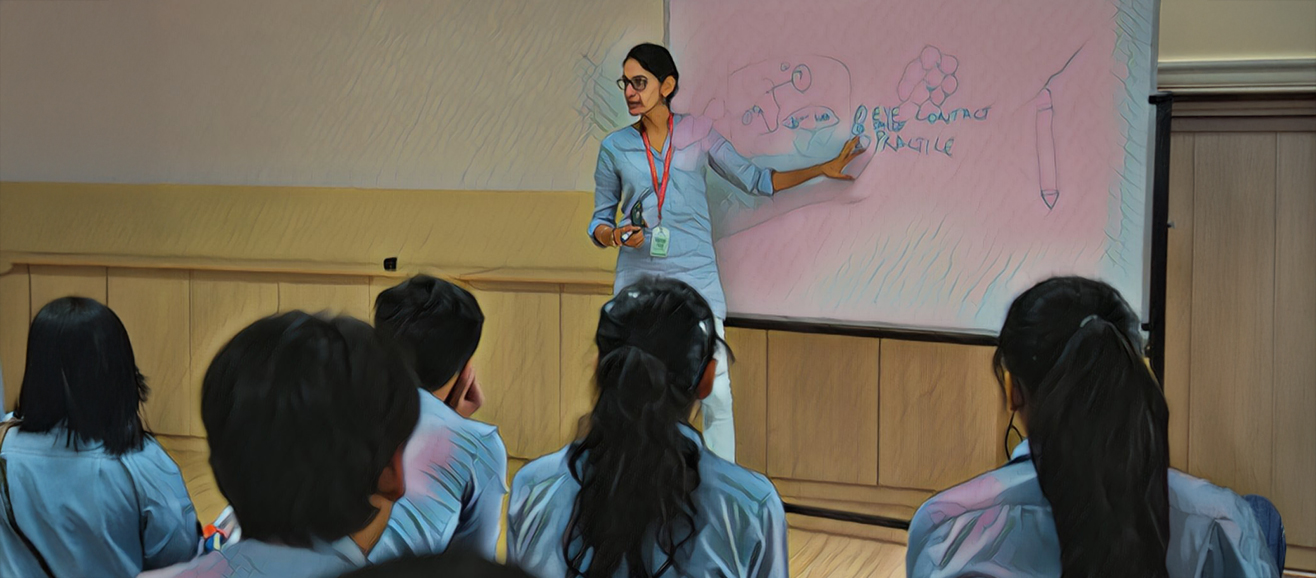
The objectives of the programme are achieved through powerful sessions led by school leadership as well as external experts. These sessions cover a wide range of essential skills, including storytelling, entrepreneurial acumen, leadership development, effective communication, social-emotional learning, and an exploration of historical and contemporary issues. Each session is thoughtfully designed to bridge the gap between academic learning and real-world application, equipping students with the knowledge and perspectives needed to navigate an ever-evolving world.
Imagine stepping into a classroom where subjects go beyond academics and become a medium to understand the world around us. In one such session, students were challenged with a thought-provoking question: "Why study history?". At first, the answers revolved around exams and knowledge. But as the discussion unfolded, History transformed from a textbook subject into a living, breathing narrative of choices, consequences, and lessons. The session delved deep into subjects like the partition of India, bringing to life the powerful stories of leaders who shaped the nation's destiny. Students examined how Sardar Vallabhbhai Patel’s efforts unified over 500 princely states, a feat that laid the foundation of modern India. They debated the implications of those decisions and how they still echo in contemporary discussions on geopolitics. With curiosity sparked, they left the session anticipating the next module. They weren’t just learning History; they were understanding its impact, questioning narratives, and connecting past events to today's world.
Past sessions have brought together a diverse range of voices, offering valuable insights across fields. From storytelling and entrepreneurial thinking to the art of communication and social-emotional learning, each session has inspired students to think deeply and differently. Explorations into Post-Independence India have brought history to life, while discussions on leadership have encouraged reflection and growth. Together, these experiences have broadened horizons and enriched student perspectives in meaningful ways.
As the coordinator of ‘Education for Life’, I have had the opportunity not only to understand the vital importance of implementing the programme but also to see the positive impact the sessions have had on young minds.
The world students step into is dynamic and ever-evolving. The programme, I am sure, will prepare them for the VUCA (Volatility, Uncertainty, Complexity and Ambiguity) world and discover deeper levels of purpose, meaning, and happiness. It will also give them the lasting ability to adopt, adapt, and assimilate the ever-dynamic nature of life itself.
As they move beyond the classroom, they carry with them not just the lessons but the confidence to shape the future with purpose and clarity, enabling young learners to live joyfully while also exploring the path to success with aplomb!
Vikas Pahwa
Vikas Pahwa is a senior school educator, International Curriculum at Shiv Nadar School, Gurgaon, HOD for Individuals and Societies, EFL coordinator, Shiv Nadar School. He is an Alumnus of Delhi School of Economics. He has hosted fireside chats with historian Manu S. Pillai and economist Dr. Montek Singh Ahluwalia. He has a passion for history, poetry, heritage walks, and podcasts.
More From EduOpinion